

If you are researching hair restoration in Gauteng, you have likely encountered a massive amount of conflicting information. As a medical professional treating hair loss, I see many patients who are highly motivated to restore their hair but are hesitant because they do not know what actually happens on the day of surgery.
The days of painful “hair plugs” and long linear scars are over. Today, the gold standard for permanent hair restoration is Follicular Unit Extraction (FUE).
Whether you are a corporate professional seeking to restore your hairline without a noticeable recovery period, or someone looking to reverse years of progressive thinning, this guide explains exactly what to expect from an FUE hair transplant at LoneStar Medical Center in Johannesburg.
What is an FUE Hair Transplant?
FUE (Follicular Unit Extraction) is an advanced, minimally invasive microsurgical procedure. Instead of removing a large strip of skin from the back of your head (the older FUT method), we use a specialized micro-punch tool to extract individual, healthy hair follicles one by one from your “donor area” (usually the back or sides of the head, where hair is genetically resistant to balding).
These follicles are then meticulously implanted into the thinning or bald areas at the precise angle, depth, and direction of your natural hair growth.
The FUE Advantage:
- No Linear Scarring: You can wear your hair as short as you like after recovery.
- Minimally Invasive: The procedure is performed under local anesthesia; you remain comfortably awake.
- Rapid Recovery: Most patients return to desk work within 3 to 5 days.
- Permanent Results: The transplanted hair is highly resistant to the hormone (DHT) that causes male pattern baldness.
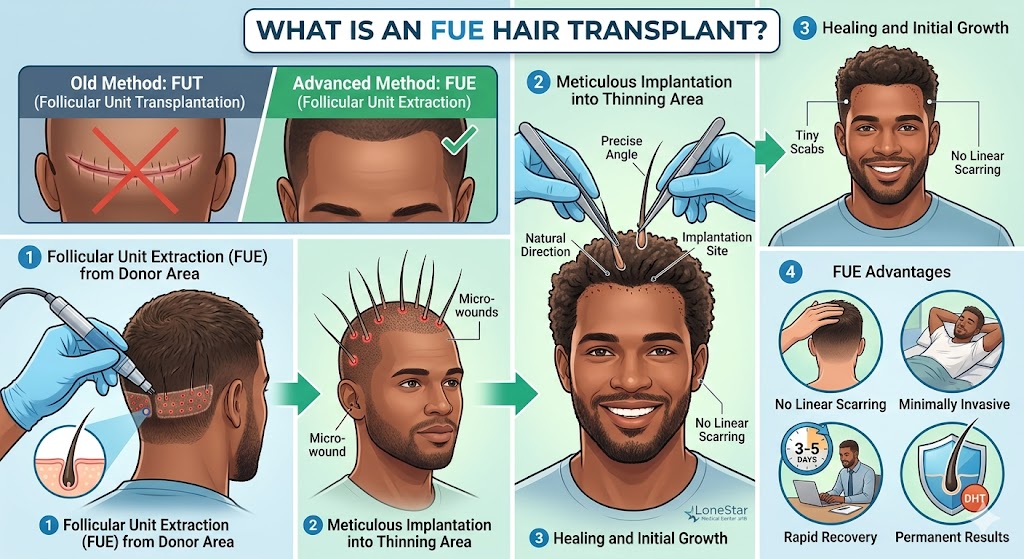
The Patient Journey: From Consultation to Full Growth
1. The Medical Consultation
A successful transplant begins with an accurate diagnosis. Not all hair loss requires surgery. During your consultation at our Fordsburg or Southgate Mall clinic, we examine your scalp to determine the root cause of your hair loss, assess the quality of your donor area, and map out a natural-looking hairline that suits your facial structure.
2. The Day of the Procedure
FUE is a meticulous process that takes anywhere from 4 to 8 hours, depending on the number of grafts required.
- You will arrive in the morning and be given a mild sedative and local anesthesia to ensure the scalp is completely numb.
- While the extraction and implantation take place, you can relax, listen to music, watch a movie, or even sleep.
- You will go home the exact same day with a light protective bandage.
3. The Recovery Timeline (What to Actually Expect)
Understanding the timeline is crucial for managing expectations. Your new hair needs time to anchor and cycle through natural growth phases.
- Days 1–7 (The Healing Phase): You will experience mild swelling and redness. Tiny scabs will form around the implanted grafts. It is critical during this week to sleep with your head elevated and avoid touching the grafts. By day 7, the scabs will gently wash away.
- Weeks 2–4 (The “Shedding” Phase): This is the part that panics patients, but it is 100% normal. The transplanted hairs will fall out. Do not worry—the root (follicle) remains securely anchored beneath the scalp.
- Months 3–4 (The Sprouting Phase): You will begin to see fine, new baby hairs emerging from the scalp.
- Months 6–8 (Noticeable Density): The hair begins to thicken and mature. You will see a significant cosmetic improvement and can start styling your new hair.
- Months 12–15 (Final Results): The transplanted hair has reached its full thickness and density. The results are permanent, and you treat it exactly like the rest of your hair—cut it, style it, or dye it.
Who is the Ideal Candidate for FUE?
FUE is highly effective for both men and women, provided you meet certain medical criteria:
- You have a stabilized pattern of hair loss.
- You have sufficient healthy donor hair on the back or sides of your scalp.
- You have realistic expectations about the density that can be achieved in a single session.
For patients experiencing early-stage thinning who are not yet ready for surgery, we often recommend non-surgical interventions like PRP (Platelet-Rich Plasma) Therapy to strengthen existing hair and halt further loss.
Why Choose LoneStar Medical Center in Johannesburg?
Hair transplantation is as much an art as it is a medical science. Designing a hairline that looks natural requires a deep understanding of facial aesthetics and precise angulation of every single graft.
At LoneStar Medical Center, we do not treat hair loss as just a cosmetic issue; we treat it with strict medical protocols. From the initial clinical diagnosis to your 12-month follow-up, your procedure is guided by highly trained medical professionals dedicated to your safety, comfort, and confidence.
Ready to restore your hair? Skip the guesswork. Book a confidential hair restoration consultation with Dr. Aziz today at our Fordsburg or Southgate Mall clinics.
(Call +27 78 419 9335 or visit our Contact Page to schedule your assessment).